Thursday, June 4, 2009

Lladró, May 9


At last, I am able to update! It will take several entries to catch up, but I hope you enjoy reading them as much as I enjoyed living them. . . I begin with a factory of sculptures of breathtaking beauty, the product of great care. . . Lladró.

Lladró makes all of its works of art in La Ciudad de Porcelana, the City of Porcelain, a complex on the outskirts of Valencia. I had vaguely heard of the company before, and even seen a pair of figurines, but I had no idea how extensive the process to make them really was. This explained the beauty of the complex, with its own swimming pool and human chess board--artists of that degree deserve to be treated well by the company.

The tour began with a few films on the inspiration and sculpting of the original models. After that, we entered the factory itself, where sadly, photography was not permitted. To me, it looked less like a factory than a spacious, well'lit workshop. We watched as they poured the moulds and opened them, taking great care to preserve the detail of the more delicate features.

Then, we watched as women cleaned the pieces and cemented them together with liquid porcelein. This is how the figurine takes its eventual shape. The next station was where the figurines were being painted, everything but the face. They paint with transparent paints that later change colors in the oven, so an orange cat will look purple when it is first painted--very fascinating. Then we saw one of the women painting faces. This is very difficult, as it is done with liquid porcelein to add depth to the expressions, and demands a very fine brush.

My favorite station, though, was the one where they make the tiny porcelain tiny porcelain flowers for the sculptures by hand. Watching her roll it and shape it was mesmerizing. I could never dream of being able to create something that small, detailed, and beautiful so quickly.

The guide led us out of the factory and into a museum of almost all of their pieces. I was amazed at their detail and life-like beauty. Naturally, this was reflected in the price--there was one piece going for 120,000 euros--but the quality was reflected in it. My favorite, I think, was not that one, but a series of three sculptures, each showing a couple. It showed the growth of love by flowers spreading over them throughout the series until in the last set, they were covered in bright flowers. The effect was breathtakingly lovely.

We went to an exposition of slightly less expensive pieces after that, but it was still out of any of our price ranges. I find it a wonder they can sell such things in this economy--though the beauty deserves the price.

After that, we went to an excellent horchatería, Daniel´s, which had wonderfully cool iced horchata and warm fartones, fresh from the oven. This is a very traditional Valencian snack, and Daniel´s is widely recognized as one of the best places in all of Valencia to get it, especially the fartones, which they bake fresh. I enjoyed this immensely, wishing I could return. But then again, there were even more delightful things to enjoy that week, which turned out to be one of the busiest of the year.

As for now, things are nice and slow, and I´ve been filling my afternoons with walks through the trails behind the school (this afternoon I had the fun of running into not just a rabbit, but a snake). I can now definitively say that I will be back in the States in the wee hours of the morning on July 30. Until then, I hope that those of you who have tests do well, and that those of you who are in graduation weekends enjoy the celebrations, and that everyone else has an absolutely wonderful summer.

Tuesday, May 5, 2009

Activity Craze, May 5


Ever since we got back from Castilla, the school has been keeping us busy with various activities. I feel silly now, almost, for making up my own on a fine evening, my friend Jenny and I photographing each other with our Toledo blades right after we got back--the pictures are cool, at least. Soon after that peaceful night, the world seemed to break into a flurry of activity.

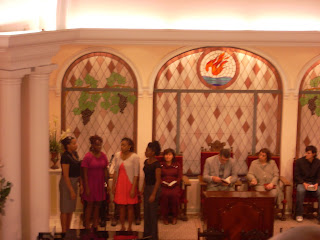
Last Sabbath was Musicalia, the Spanish equivalent to a choir festival. It's not quite the same, though--they do not collaborate on the same repertoire, but show off the best each of them has to offer. The one that impressed me the most hailed from the first gypsy SDA church in the world--a fact they're quite proud of. I've seen gypsies here do flamenco tablaos, but when they take their style of music and rhythm and turn it into an expression of praise, it's amazing. There was one girl who could've only been nine or ten, but when she sang, she had lungs of iron.

The local school choir and orchestra also put on an excellent performance, putting their music together into a commentary on all the paradoxes of human nature. It was called, "El Hombre Es Una Cosa Curiosa" (Man Is A Strange Thing). I actually cried during one of their songs about the environment, of all things.

Last Wednesday we had an open dorm night, which they make a much bigger deal of here than they do in the States because they only do it once a year. I had fun showing off my room and handing out candy--for this, I was accused trying to buy votes in the contest for most original room. That kind of bothered me, because at PUC mere candy would not be sufficient hospitality for open dorm night. The room that won totally deserved it. Seeing the guys' dorm was fascinating--they have way more space than we do, space enough for couches! I don't know how they live with all the noise, though.

After the tour of the dorms, they served us all fresh, cool horchata--mm, that was good.

Sunday, though, of all the activities, was the one I had been looking forward to the longest. In the City of the Arts and Sciences, there's a massive aquarium called the Oceanografic. I had always seen it, and never been inside, and we finally got to go.

The variety in the aquarium was amazing--not even Monterey has such a variety of species, even if their collection is larger. One of my favorite creatures was a sea dreagon, a cute little things. There were even some familiar California species, like the Garibaldi. There were others that I can honestly say I've never seen before, not even on the Discovery Channel, like the Giant Spider Crab which hailed from Japan. The dolphin show was neat, as dolphin shows go--I don't think the Sea World trainers back in the States trust their whales and dolphins that much.

There was one part that was really neat where we could walk through a glass tunnel under one of the tanks and sit in a bubble inside of it. It felt like we were actually underwater with the fish.

More than the sea life of the Oceanografic, almost, I really liked the gardens they were in and the birds they had. There were flamingos, black-necked swans, and some bright orange thing I never caught the name of that was really cool. The perfect weather made this even more beautiful. . . the first time I'd worn shorts since Fallas.

Last night, I somehow managed to get roped into doing worship an hour and a half before the fact. I cobbled up something together really fast, and was almost surprised when it turned out to be my best worship talk of the three I've given here this year. It left me exhausted, though. . . and then today hit me in the face. Life is getting crazy as we approach the end of our last quarter. Not only do we have all of these wonderful activities, but a mountain of homework, projects, and preparation for DELE. DELE is a test which, if one passes it, grants a diploma recognized internationally which acknowledges a person's level of proficiency in Spanish.

So, between one thing and another, life hums along. I hope you're all having a wonderful week, full of opportunities.

Sunday, April 26, 2009

April 16-19


Our first full day in Madrid was a very full one. It started with a guided visit to the Museo del Prado, and I got so much more out of it with the guide than I had with my parents. He took us through the most important works of El Greco, Velazquez, and Goya. Velazquez was my favorite. I absolutely loved the detail he throws into to expressions of his paintings of court fools. I was also really impressed by the story of his particular painting of the Crucifixion of the Christ. The king of his time was so repentant from his sins that he commissioned Velazquez to create the most spiritual painting in existence. On my own, I saw the collection of paintings by Hieronymus Bosch--they are even more impressive in person than online. I also saw an exposition of English paintings of Sleeping Beauty and the Arthurian legends. These were so soft in their light, like a dream.

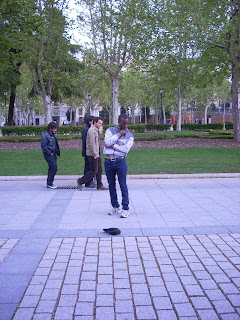
Our next appointment of the day was to see the Palacio Real, but our guide didn't show up on time, so we waited outside for an hour. One of our students posed as one of the street performer human statues with a hat in front of him. A crowd gathered in front of him, and in five minutes there was more money in his hat than the local artists had been able to make in an afternoon. A man told him off, with a somewhat racist comment, but instead of reacting with anger, this student calmly collected his hat and emptied it into the can of one of the street performers. I wish I was capable of such calm in the face of rudeness.

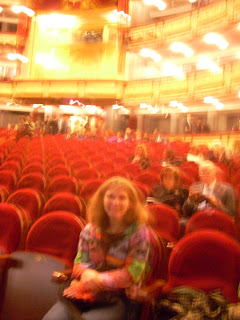
I went straight from the palace to the opera house, paying at 6:15 for an opera that was to start at 7. For 8.50 euros, I got a proscenium seat, but when I took my ticket to the usher, she realized that there was a spotlight there and transferred me to the front row. I felt strange there in my jeans, especially when a well-dressed man sat down at my right and a number of people started to greet him. I listened in and realized with a shock that he was the director of the opera, Monteverdi's Il Ritorno d'Ulysses a Su Patria (The Return of Odysseus to His Homeland).

It was thrilling. I loved it, every minute of it, from Minerva's playful meeting with Odysseus on the beach of Ithaca to the contest of the bow with the suitors. I was so close, I could see the finite expressions on the faces of the singers. The one part I didn't like was sitting through a five-minute aria about how hungry one of the characters was when I hadn't eaten anything in hours. Because it was opening night, it ran extra long with the applause, and I got back to the hotel a little late, to discover that someone had attempted to rob my friends on the metro. Everyone's adrenaline was so high, no one got to bed very early that night, either.

We went to church in the morning, and there was a lovely sermon on the Holy Spirit. Also, some of our classmates sang a lovely special music. Afterwards, Jenny was having a bad allergic reaction to something, so we returned to the hotel to get her medicine, then set out again. We walked to the Plaza Mayor--quite a distance, especially if one gets lost on the way. We enjoyed its many colorful street performers before eating lunch at the same kebab place where my family and I had eaten Chritmas eve dinner. I enjoyed my baba ghanouj immensely. Then, we walked all the way to the arc where we were supposed to meet the school--but we didn't find them. So, we walked back to the hotel, stopping to observe a protest in favor of a third republic. This was interesting, though it seemed a little silly to me.

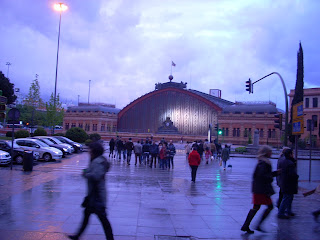
Once we got back to the hotel, even though I was tired already, I headed to the Reina Sofia Museum to see Picasso's Guernica, and I've got to say--it is huge. More impressive to me, though, was all the documentary footage near it about the Spanish Civil War. The rest of the museum just confused me. Dali, as it turns out, did film as well as strange paintings, and this made my head hurt. There were very few pieces in this museum I actually liked, but then again, that was probably just because I was so tired. Going back to the hotel in the rain, passing the illuminated Atocha train station, my feet burned with pain and I collapsed onto the bed when I got there, not to move again until morning.

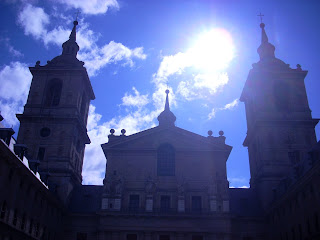
I could not believe that they saved the Escorial for the last day--it's the largest historical building in Spain. We all saw it and groaned, our feet dead. It is designed to look like a grill, in honor of San Lorenzo, who was martyred on one. We started with the library, which was by far my favorite part of it. Their extensive collection is stored in a strange way--with the spines facing the wall. For this, their large collection of Arab texts, Biblical manuscripts, and books condemned by the Inquisition are all still in excellent condition. The NEWEST book in the collection is 300 years old. Over the library door is a foreboding message that if anyone takes a book out, they will be excommunicated. In the time that was written, that wasn't just a threat of eternal damnation--it was cause for the Inquisition to take everything, and torture and kill the poor person who just wanted to take a book home.

The king who built the Escorial, Felipe II, was a man of strange contrasts. He married four times, collected Bosch's paintings, and ordered the Inquisition. One of the things that fascinated me were some early maps of America--it's impressive how accurate they were for having nothing but military reports on the territories. The main attraction of the Escorial, though, are the extensive royal burial rooms. In one room, there are over ten Spanish kings and their wives buried. This did not impress me as much as the incredibly beautiful tomb of the infamous Don Juan--there's a very life-like sculpture of him over it. As of now, no one knows where the current king, Juan Carlos, will be buried, as there is no more room left in the crypt of the kings.

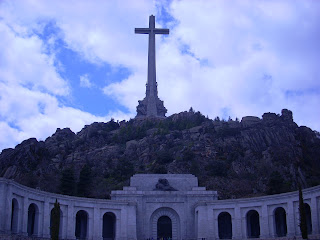
Our last stop on the trip was La Valle de Los Caidos, or the Valley of the Fallen, where the dictator Franco is buried. At one time, such a monumental structure would have impressed me, but it filled me with a sickening feeling. The cross, which is as tall as the Eiffel Tower in Paris, exists only for one man, who killed anyone who disagreed with him. When I walked through the cold, tall cathedral dug into the earth, I felt almost threatened by its monumental size--as large as the Sistine Chapel in Rome. Beholding Franco's grave, shivers went down my spine. The teacher's wife explained to me how people would just mysteriously disappear--the Adventist church had to meet in secret for fear of being discovered and sent to jail.

I couldn't get out of there fast enough, to look at the beautiful valley it was built in, instead of the monstrosity it was. My reactions were so powerful, I had to record video on the spot to try and sort through it all. I was confused, at how people do these things to each other--how power corrupts and makes the powerful treat those under them cruelly. I returned to the school, pensieve. I came to Europe hoping to understand not just language, but history better, and I see certain themes repeat.

The same story happens over and over again. One man becomes more powerful than the rest, then uses his power against those he should be serving. I don't know if there is a solution, other than the hope in a God who is more just than man, fairer and more loving than the people He created. If I had any doubts as to which profession I should dedicate my life to before now, they are now wiped away. I hope that each of you comes to know, at least in part, this one hope, this one solution to the pain and problems that plague us all

Thursday, April 23, 2009

Segovia, April 15-16


Our journey through Castilla continued in Segovia. When we arrived, I was tired, so Jenny and I went to a Pans and Company to people watch while enjoying the cheap food. It was fun, picking the tourists out from the locals. We walk past the Roman Aqueduct to our hotel. That evening, there was a lot of visiting in between rooms, perhaps because of how little there was to do in Segovia--the company was nice, anyway. After they left, Jenny and I spent some time drawing, then attempted to sleep, a wasted effort. First, it was too hot to stand. Then, with the window open to allow for a nicer temperature, the noise was unbearable.

So, groggily the next morning we set out on a walk around the Roman Aqueduct. It really is a spectacular work of architecture, held together by nothing but gravity and the placement of the stones. It stretches on for some distance, as far as the eye can reach. . . truly one of the wonders of the ancient world.

We walked through Segovia, enjoying its charming view, until it started to rain. We visited a cathedral to fill the time in a nice, dry place. Its greatest beauty was in a room filled with many tapestries lit in a soft, gold light. Also, it boasted of large cupulas--this particular cathedral was very old, with some vestiges of its twelth century romanesque architecture remaining.

After that, we approached the Alcazar of Segovia, and I believed immediately the rumors I'd heard of it being the inspiration for Disney's Sleeping Beauty castle. Inside, we found it to be rich in history--it dated back to the Arab times, with many mozarabe ceilings, intricately put together. I particularly liked the coin press next to the armory. There was a cool-looking tapestry, too, of Isabel's coronation with the eyes all blacked out in honor of the patron saint of the blind celebrated that day.

We climbed the tower of the Alcazar, and beheld the glory of the skies shifting from rain to sun, bathing Segovia with lovely light and shadows. I could've ended the day on that happy note, but our visit to the Granja was yet to come.

La Granja was built by the first of the French Borbon kings of Spain (the same dynasty that has the throne today), because this poor soul missed Versailles. I could definitely see the influence of Versailles in it with the lines of its gardens, the projection of power, and the endlessly glorious ceiling frescos. I was a little startled to find that this particular kind actually shared a bed with his queen--something unheard of in that era. More interesting, though, were the decorative tastes of this particular queen--she made one room of just Chinese lacquered panels fit in with the frilly French style. I did rather like the indoor fountains and there was a statue of a woman veiled that was absolutely transcendental in its delicate beauty.

My friend Lillian and I took the effort to find and explore the maze in the garden. I had regretted not exploring the one in Versailles, and this was my chance. It was actually a rather surreal experience, as it was hailing at the time. Nothing like pebbles of ice falling from the sky to make one solve a maze quickly.

After so much walking, by the time I got to Madrid, I was dead on my feet. I ate dinner with Jenny at a very reasonably priced Chinese restaurant near Atocha, and slept like a rock. Madrid would be full of more than enough wonders to tax my energy.

Energy which, thankfully, seems to have returned since I got back, especially in the wake of mail I've been receiving this last week. Many thanks for the care expressed in emails, in care packages, and letters. . . that really makes my week, you know? I've been doing my best to keep up with the wonderful things you've been doing for me, though it's so overwhelming. . . I love you all. Thank you.

Monday, April 20, 2009

Toledo, April 14-15


I just got back from a tour around Castilla (the Spanish provinces of Castilla La Mancha and Castilla y Leon), and it was so incredibly crammed that it seems the better part of valor to break it up into three episodes, one for each city (Toledo, Segovia, and Madrid). I was amazed by how little I repeated from when I visited Toledo and Madrid with my parents over Christmas, and my brain was going crazy from the sheer density of information presented to us by the end of the trip.

Our first day in Toledo was nice enough, at least. The only thing scheduled to do was the cathedral, and I'd seen that already, so afterwards my friend Jenny and I went looking around the sword shops trying to find her a perfect match. I wistfully thought of my grandfather, who would be really in his element here, and did my best to apply everything I'd ever learned about swords from him to help her find the best sword for her money. The one she settled on was a fantastic hand-and-a-half broadsword, a replica of the one carried by Carlos V, the first of the Hapsburg kings in Spain. I enjoyed watching her show it off, and bought myself a much more modestly priced Templar dagger--though I found myself wistfully eyeing the swords of the Catholic kings and Christopher Columbus.

That night, after a warm bath, I did something silly. As I was showering off the bath salts I was using, in the low light of the room, I reached for conditioner. I realized after a moment that it smelled strange to be conditioner, and realized I was washing my hair with body lotion. Yeah.

Our morning was packed. We walked out to where we could see the country side, and enjoyed it for a bit before our first museum of the day opened. It was the Sefardi Museum, which boasted of the best-preserved synagogue in Spain and many fascinating artifacts from the community of Sefardi Jews who lived in Spain before they were expulsed. I regretted not having taken biblical hebrew already as I peered over their texts--the Sefardi language is basically Spanish written in Hebrew characters, and seems like it would be fun to read. They also had fascinating footage on how the Jews celebrate various festivals in the Middle East.

From there we went to a beautiful Catholic monastery done in the same style as the Grand Place in Brussels. Its cloister captivated me in particular--it was absolutely gorgeous. We also saw El Greco's most famous work, El Entierro de Conde Orgaz, which has the entire Catholic religion's theology more or less in the same painting. I'm not much of a fan of El Greco, but the size of this one was impressive.

Then, after the school-sponsored visits were done with, I made the mistake of visiting the local Torture Museum. Yeah, nothing quite like that to make you sick to your stomach. It wasn't just seeing the instruments of torture themselves, but who the Inquisition used them on. Jews, gays, women, Waldenses, gnostics. . . the list goes on. Looking at a list of beliefs of so-called "Judaizers" who were sought out, tortured and killed by the Inquisition, I found more than half of them reflected in my own. I later bought a Star of David done in the local damasked style so I wouldn't forget what I'd learned, even though the impression was burned so strongly on my brain. I don't ever want to do that to anyone else. . . or forget how it happened to others who share my beliefs.

To cheer up a little from these weighty thoughts, I revisited one of the museums I'd gone to with my parents, this time taking Jenny with me. Even though I'd seen it before, it's beautiful exhibits on almost every subject from Spain in the nineteenth century captivated me. I discovered a room with a window of a beautiful view of the countryside. That was the thought I left Toledo on--the loveliness of its countryside.

I hope you all have a wonderful week, free of nausea-inducing torture museums.